Bridge
Words can create a
chasm or build a bridge. Please
let mine be the bridge.

SARAH KOOPS VANDERVEEN - LAGUNA BEACH IN POEMS AND PICTURES
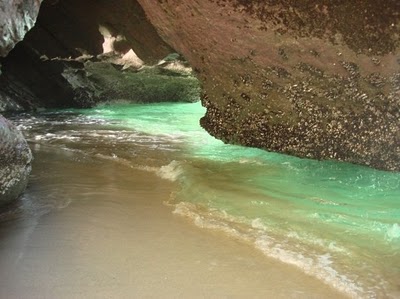
David and I went stand-up paddling today and it was gorgeous. He showed me some caves you have to swim into to get inside—"Pirate's caves," he calls them, which I love. And the color and clarity of the water—"green glass," as David wrote in his blog about our expedition—made me think of a poem my dad read to me when I was young.
It’s called “Overheard on a Salt Marsh,” by Harold Monro, and it became a family favorite. Dad would read it in dramatic fashion, doing the voices of both the nymph and the goblin, and it was so thrilling and mournful (and just a tiny bit scary) that my siblings and I would beg him to do it again and again. I can’t do it justice by describing it, so here it is:
Overheard on a Salt Marsh
Nymph, nymph, what are your beads?
Green glass, goblin. Why do you stare at them?
Give them me.
No.
Give them me. Give them me.
No.
Then I will howl all night in the reeds,
Lie in the mud and howl for them.
Goblin, why do you love them so?
They are better than stars or water,
Better than voices of winds that sing,
Better than any man's fair daughter,
Your green glass beads on a silver ring.
Hush, I stole them out of the moon.
Give me your beads, I want them.
No.
I will howl in the deep lagoon
For your green glass beads, I love them so.
Give them me. Give them.
No.
—Harold Monro
Sigh. That’s a hard act to follow. With thanks and apologies to Mr. Monro, a post-paddling haiku:
A sea of green glass.
Secret caves. Dolphins! Why not
a nymph and goblin?

Brassy angels in
silver-studded, baby blue
charro outfits sing
of love and longing, the stars
in the night sky, Chihuahua
and Guadalajara—home.
I love my kids because they’re my kids—that’s what moms do—and most of the time I like them too. And then once in awhile they do something that makes me really proud, and that’s just icing on this big old motherhood layer cake—really good icing, like cream cheese frosting, or maybe chocolate ganache. Today I’m proud of Schuyler. He decided on his own to participate in World Vision’s 30-Hour Famine, a worldwide movement of students who, on a designated weekend, raise funds for and awareness of those in extreme poverty. From the 30-Hour Famine web site: “For 30 hours, participants get a taste of hunger by not eating—something more than a billion people around the world experience every day. And by doing fundraising activities, community service projects, and learning more about the facts of world hunger, students are changed in amazing ways as they help others and save lives.”
With their prayers and fundraising efforts dedicated to helping Haiti, the high schoolers from our Little Church by the Sea and Laguna Presbyterian started their fast today at 11 and will not eat until tomorrow at 5. I was a little worried about how this would go, since Schuyler had a tennis match after school and a surf contest tomorrow morning—and he’ll be sleeping under cardboard boxes with the other kids tonight—but he assured me he’s tough and will be just fine. I was so humbled by his attitude that I promised to fast with him, in solidarity. I mean, if my teenager with about two percent body fat and two different sports commitments can take on this challenge, then why not me? Plus, every time my stomach growls it reminds me to pray for Schuyler and the other Laguna kids fasting with him, as well as, of course, the people of Haiti.
So, for Schuyler and his friends:
An empty stomach
and eyes wide open make for
a full heart that gives

It’s been a slow week here in lovely Laguna. But I did make it to Geo’s yoga class today, and his unlikely music choice (how will this go with the downward dog and the crow? I thought) made a good thing even better:
Yoga with Geo
and Lyle Lovett: a match made
in heaven. Who knew?
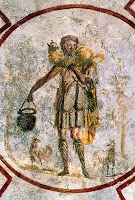
I just read today’s meditation in Frederick Buechner’s Listening to your Life, which I’ve referenced before. I don’t know what I would do without St. Fred. On days in which not much seems to happen (again, not that I’m complaining!) and I’m searching for inspiration, his writings never fail to offer some new angle on life and faith. I love his thoughts on what the parables of Jesus say about the kingdom of God, in terms of it not being a new world order or a mechanism to make us “good,” but rather a place or a state of joyful surprises, in which the lost are sought and found:
“What is the kingdom of God? Jesus does not speak of a reorganization of society as a political possibility or of the doctrine of salvation as a doctrine. He speaks of what it is like to find a diamond ring that you thought you’d lost forever. He speaks of what it is like to win the Irish Sweepstakes. He suggests rather than spells out. He evokes rather than explains. He catches by surprise.”
I really don’t feel like I have anything intelligent to add to Buechner’s wonderful commentary, but since I’m committed to writing a poem a day—good, bad or ugly—here is my haiku:
His is a kingdom
of surprises: lost sheep,
coins and sons, sought and found.
In case you were wondering
the formula for
seventh-grade science study
group equals one part
homework to six parts snacking
and smack-talking to
three parts skateboarding
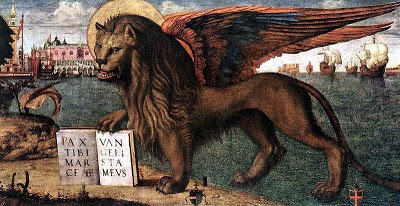
So why does a maritime city like Venice have a lion as its mascot? Wouldn't a seagull, a fish, or a duck from the marshy Venetian Lagoon be a more appropriate symbol?
The answer to that question lies in the ninth century, when--according to legend--two or three ambitious Chamber of Commerce types from Venice stole the remains of St. Mark the Apostle from his tomb in Alexandria, Egypt. William Lithgow tells the story in his "Comments on Italy" from The Rare Adventures and Painfull Peregrinations, published in 1614 and quoted in Ian Littlewood's Venice: A Literary Companion:
"They placed the corpse in a large basket covered with herbs and swine's flesh which the Musselmans [Muslims] hold in horror, and the bearers were directed to cry Khwazir (pork), to all who should ask questions or approach to search. In this manner they reached the vessel. The body was enveloped in the sails, and suspended to the mainmast till the moment of departure, for it was necessary to conceal this precious booty from those who might come to clear the vessel in the roads. At last the Venetians quitted the shore full of joy. They were hardly in the open sea when a great storm arose. We are assured that S. Mark then appeared to the captain and warned him to strike all his sails immediately, lest the ship, driven before the wind, should be wrecked upon hidden rocks. They owned their safety to this miracle."
After crossing the Mediterranean and cruising up the Adriatic, the grave robbers reached Venice and handed their cargo over to the Doge. The local religious and civic authorities quickly elected St. Mark as Venice's patron saint, and the apostle's traditional symbol--a winged lion--became the logo of the Venetian Republic.